Why Is a Missing Tooth Not a "Waiting" Problem?
Tooth loss is an important health issue that directly affects not only smile aesthetics, but also chewing function, speech quality, and self-confidence. As a dentist, the sentence we repeat most often to our patients is this: "A missing tooth is not a problem waiting quietly; it is the beginning of a process that spreads to neighboring teeth, the jawbone, and the jaw joint." That is why, in modern dentistry, implant treatment is considered the "gold standard" for restoring missing teeth.
Susurluk implant treatment is one of the dental procedures with the strongest scientific evidence, based on placing artificial tooth roots made of titanium into the jawbone. In this article, we will discuss what an implant is, the stages of treatment, who it is suitable for, its advantages, the factors that determine prices, and post-treatment care from a physician's perspective, but in simple language that everyone can understand. Our goal is to remove all the questions in your mind before you decide on treatment.
What Is Implant Treatment?
An implant is a small artificial tooth root, usually made of titanium, shaped like a screw and placed into the jawbone. The reason titanium is preferred is that it is easily accepted by the body and fuses directly with the bone; in medicine, this process is called "osseointegration" (bone fusion). A porcelain or zirconium crown that cannot be distinguished from your natural tooth is then placed on the implant, which has firmly integrated with the bone. In this way, the missing tooth is completed with both root and crown.
Long-term clinical studies show that the success rate of implant treatment performed with proper patient selection is above 95%. This rate increases even further with regular oral care and follow-up appointments after treatment.
What Are the Components of an Implant?
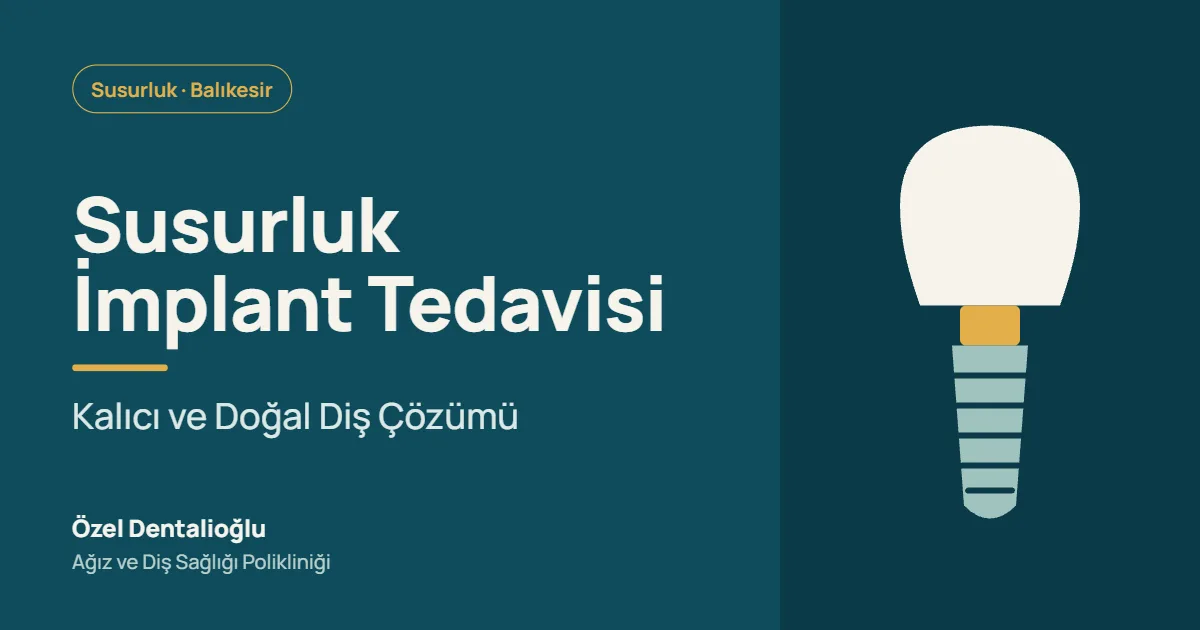
An implant system consists of three main parts: the implant body placed into the bone, the abutment that is screwed onto the body and extends out of the gum, and the porcelain/zirconium crown at the top, which is the actual visible tooth. This three-part structure exactly mimics the root-neck-crown anatomy of a natural tooth.
Who Can Have Implant Treatment?
Any adult who has sufficient jawbone, has a controlled chronic condition (such as diabetes, hypertension, etc.), and can cooperate with their dentist regarding oral hygiene is a candidate for this treatment. Are you one of those wondering, "I wonder if my bone is sufficient?" Don’t worry: thanks to supporting surgeries such as bone grafting and sinus lifting, the majority of patients who could not previously receive implants can now benefit from this treatment. The final decision is made after a detailed examination using panoramic X-rays and, when necessary, three-dimensional tomography.
How Is Implant Treatment Performed in Susurluk?
The question my patients ask most often is: "Doctor, how long does the process take, does it hurt a lot?" Knowing the process correctly removes much of the anxiety. Here is your treatment journey step by step:
Examination and Digital Planning
At the first appointment, an intraoral examination is performed; the amount of bone, bone density, and the anatomy of the nerves and neighboring teeth are assessed with a panoramic X-ray and, if necessary, dental tomography. Your gum health and general medical history (including the medications you use) are carefully reviewed. Then the implant's diameter, length, and position are planned digitally. This stage is the most critical step in determining treatment success: the more detailed the planning, the more predictable the result.
Surgical Procedure, Healing, and Permanent Tooth
Implant placement is usually completed under local anesthesia in a short time, typically 15-30 minutes. No pain is felt during the procedure; mild swelling and sensitivity in the first few days afterward are normal and can be easily controlled with prescribed medication. Most of our patients leave the clinic saying, "It was much more comfortable than I expected"; implant surgery can even be more comfortable than a tooth extraction.
During the healing period, the implant is generally left for 2-4 months to fuse with the bone (osseointegration); in the lower jaw, this period is generally shorter. During this time, temporary prostheses preserve your aesthetics and chewing function. Once fusion is complete, the abutment is placed, an impression is taken, and your crown is prepared and fixed. Now you have a new tooth that you can use just like a natural one. Are you also hesitant while chewing because of missing teeth? Implant treatment offers adaptable solutions for every scenario, from a single missing tooth to multiple missing teeth, and even fully edentulous jaws.
Advantages of Implant Treatment
"So why choose an implant instead of a bridge or removable denture?" We can summarize the scientific reasons we offer our patients as follows:
- Does not damage neighboring teeth: In a traditional bridge, healthy adjacent teeth are filed down; this is not necessary with an implant.
- Prevents bone loss: It transfers load to the jawbone like a natural tooth root and slows bone resorption.
- Natural appearance and full function: It provides the closest result to a natural tooth in chewing, speaking, and smiling.
- Long-lasting: With good care, it can be used for 10-20 years and beyond, and in most patients, for a lifetime.
- Restores self-confidence: It eliminates the anxiety of a moving denture.
Do you also hesitate to smile because you fear your denture will move? The stability offered by implants makes a difference not only in your mouth but also in your social life.
Factors Determining Implant Treatment Prices
Implant prices are not read from a fixed list; they are shaped by personalized planning. The main variables that affect pricing are as follows:
| Implant brand and origin | Creates differences between domestic, European, and premium segment systems |
| Number and location of missing teeth | Single tooth / multiple missing teeth; front area / back area distinction |
| Need for bone graft or sinus lifting | Additional cost arises if supportive surgery is required |
| Superstructure (crown) material | There is a price difference between zirconium and porcelain |
| Additional procedures | Requests such as temporary prosthesis, gum aesthetics, sedation |
Important warning: Evaluating an implant only by the price of the "screw" is misleading. The actual cost is the whole package, including planning, surgery, superstructure, and regular follow-up. At the end of the examination, you should be presented with a transparent treatment plan with no financial surprises. In cases where there is no rush, getting a second dentist's opinion is also a good approach.
Post-Treatment Care: Extend the Life of Your Implant
An implant does not decay; however, the gum and bone around the implant are susceptible to inflammation, just like natural teeth. In medicine, this condition is called peri-implantitis, and it is one of the most important causes of implant loss. The good news is that prevention methods are as simple as natural tooth care.
Things to Pay Attention to in the First Few Days
During the first 24-48 hours following surgery, avoid very hot foods, do not rub the surgical area, stay away from cigarettes and alcohol, and do not engage in strenuous exercise. Following your doctor's recommended cold compress and medication regimen will help the swelling subside quickly. Since smoking significantly slows healing, quitting or minimizing it during this period is the greatest investment you can make in your implant.
Long-Term Care and Dental Checkups
Brushing twice a day with the correct technique, using dental floss and interdental brushes, mouth irrigators when needed, and professional checkups every six months... These four habits are like the real guarantee of your implant. If you love and protect your implant as much as your natural teeth, it will serve you reliably for years.
A Healthy and Confident Smile Is Possible in Susurluk
A missing tooth is a problem that grows the longer it is postponed; bone loss, shifting of neighboring teeth, and aesthetic losses eventually come knocking. Susurluk implant treatment breaks this chain with its scientifically supported, comfortable, and permanent solution. Have you lost a single tooth, or does your entire jaw need renewal? It doesn’t matter; with proper planning, it is possible to achieve a natural-looking, strong, and long-lasting result in both scenarios.
Remember: the best implant is the one planned with the right examination. In our clinic in Susurluk, you can schedule a preliminary evaluation appointment and review the current condition of your teeth together with an expert eye. Don't forget to share your experiences and questions with us in the comments. Wishing you healthy smiles!
This article is for general information; consult your dentist for decisions about your oral and dental health.